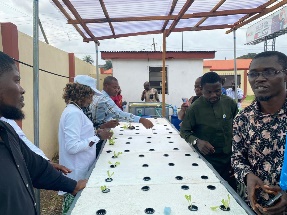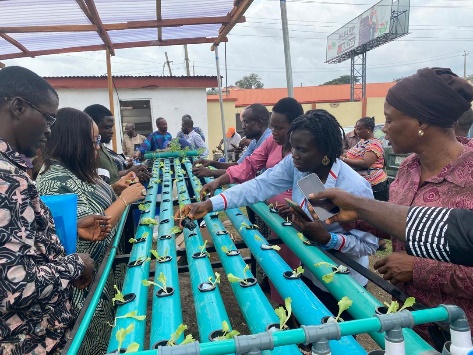
On 3 and 4 November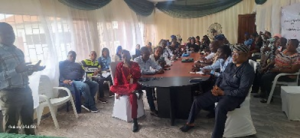 2025, KANI and the Japan International Cooperation Agency (JICA), with support from the Oyo State Agribusiness Development Agency (OYSADA), trained 50 participants in aquaponics at a new demonstration facility in Ibadan. They were 35 fish farmers from Lagos and Oyo States and 15 agricultural extension officers. Participants asked for further support to build their own systems.
Aquaponics training at a glance
| Item | Detail |
| Event | JICA and KANI Aquaponics Training for Youths |
| Dates | 3 to 4 November 2025 |
| Place | OYSADA demonstration facility, Ibadan, Oyo State |
| Participants | 50: 35 fish farmers (Lagos and Oyo States) and 15 extension officers |
| Coordinator | A researcher from the International Institute of Tropical Agriculture (IITA) |
| Delivered with | KANI members, including the KANI President and a member from the Standards Organisation of Nigeria |
What is aquaponics?
Aquaponics is a food production system that combines fish farming and vegetable growing in one recirculating system.
How does aquaponics work?
This is a general explanation of the method:
- Fish produce waste in the water.
- Bacteria convert the waste into nutrients that plants can use.
- Plants take up the nutrients and so clean the water.
- The cleaner water returns to the fish tank.
Because the water is reused, the system needs far less water than conventional farming, which is why it suits places where water and land are limited.
What did the training cover?
The training had four objectives:
- Introduce participants to the principles of aquaponics.
- Give hands-on experience in installing, building and maintaining aquaponics facilities.
- Encourage participants to apply and share what they learned in their farming and extension networks.
- Promote resource-efficient, environmentally responsible agriculture aligned with global sustainability goals.
Participants studied system design, water recirculation, nutrient management and routine maintenance, and practised hands-on.
What was built and what are the results?
- A demonstration facility stocked with 150 juvenile catfish and more than 300 lettuce plants, which will keep serving as a learning centre.
- Alignment with seven UN Sustainable Development Goals: SDG 2 (Zero Hunger), 6 (Clean Water and Sanitation), 8 (Decent Work and Economic Growth), 9 (Industry, Innovation and Infrastructure), 12 (Responsible Consumption and Production), 13 (Climate Action) and 17 (Partnerships for the Goals).
- Participants asked for further financial and technical support to replicate the systems on their own farms.
Frequently asked questions
What is aquaponics training?
It is hands-on instruction in building and running a system that grows fish and vegetables together.
Who took part in the Ibadan training?
Thirty-five fish farmers from Lagos and Oyo States and 15 agricultural extension officers.
Can I fund or co-host the next training?
Yes. See how to partner with KANI.
Next step
Want to fund or host a training programme? Partner with KANI.